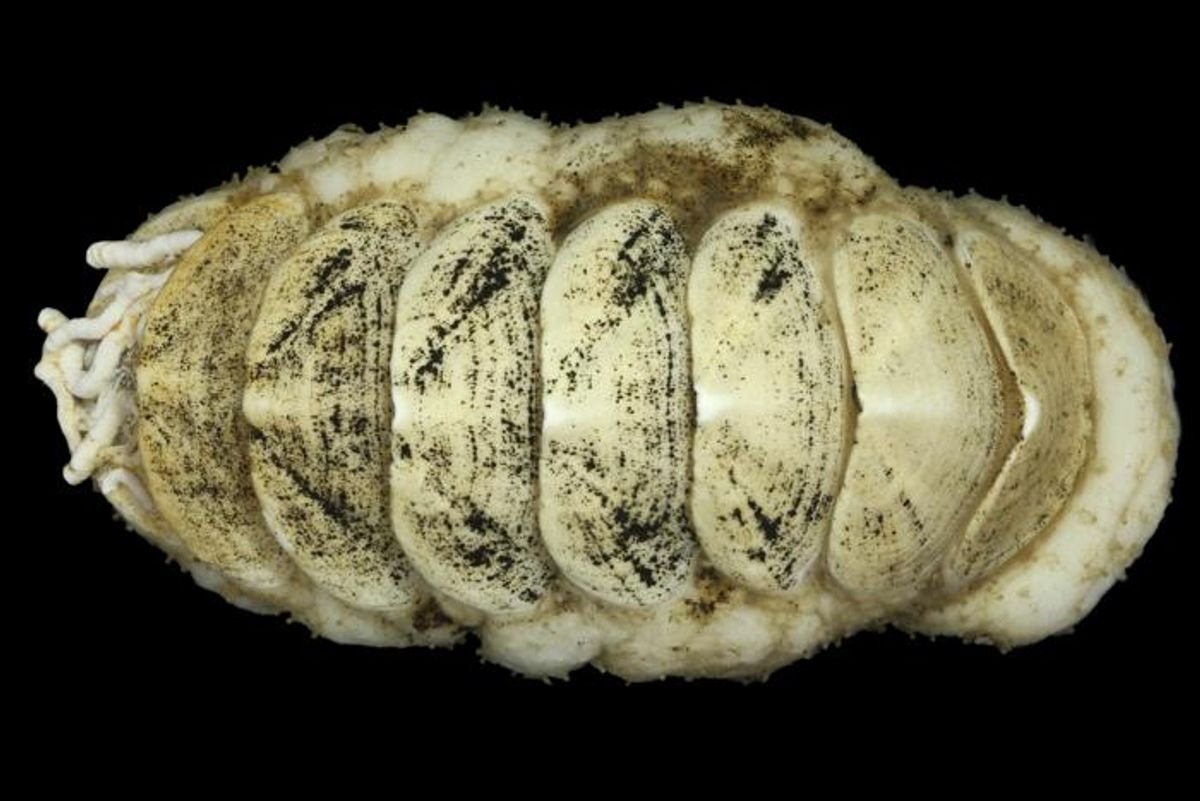
A newly discovered deep-sea creature has officially been named, and unlike most species descriptions tucked quietly into academic journals, this one belongs to the internet. After more than 8,000 suggestions poured in from across social media, researchers have christened a rare deep-sea chiton Ferreiraella populi — a name that literally means “of the people.”
The unusual naming process was led by the Senckenberg Ocean Species Alliance (SOSA), in collaboration with Pensoft Publishing and science communicator Ze Frank. The results, published in Biodiversity Data Journal, highlight both how little we still know about life in the deep ocean and how public engagement is beginning to reshape the scientific process.
“The new species represents an addition to a lineage of chitons that has been little researched to date and provides further evidence that deep-sea wood-fall ecosystems host highly specialized and still largely undiscovered communities,” said Julia Sigwart, co-chair of SOSA, in a press release.
Worms near Ferreiraella populi’s tail that survive by consuming its waste.
The new species is a chiton, a type of marine mollusk often described as a cross between a snail and a beetle. Unlike most mollusks that have a single shell, chitons are armored with eight overlapping shell plates, an anatomy that allows them to cling tightly to uneven surfaces or curl into a protective ball.
This particular species belongs to the genus Ferreiraella, a rare and highly specialized group that lives exclusively on sunken wood in the deep sea. Researchers first discovered the species in 2024 in the Izu-Ogasawara Trench near Japan, at a depth of 5,500 meters.
The chiton also hosts a tiny community of worms near its tail that feed on its excrement, forming a miniature ecosystem. Chitons are found in environments ranging from shallow reefs to depths of nearly 7,000 meters, surviving extreme pressure and cold in areas where sunlight never reaches.
Read More: This Adorable Bumpy Snailfish Is One of Three New Species Discovered in the Deep-Sea
How Did the Internet Name a New Species?
The naming effort began when Ze Frank featured the chiton in an episode of his long-running YouTube series True Facts, which launched in 2012. Viewers were invited to propose a scientific name and justification for their choice — and they responded enthusiastically.
Viewers submitted more than 8,000 suggestions in just one week.
The specific epithet populi is a Latin singular noun meaning “of the people,” and 11 different contributors independently suggested it. Other notable proposals included Ferreiraella stellacadens, or “shooting star chiton,” and Ferreiraella ohmu, a nod to a chiton-like creature from Studio Ghibli.
How Scientists Name New Species
Every newly discovered species must receive a scientific name as part of its original taxonomic description, following Carl Linnaeus’ system of binomial nomenclature. Each name includes a genus and a specific epithet, often inspired by physical traits, geographic origins, mythology, or specific individuals involved in the research.
“It can often take ten, if not twenty years, for a new species to be studied, scientifically described, named, and published,” explained Sigwart.
In this case, the internet didn’t just help name a new species, but aided in bringing the chiton into public conversations.
“Ferreiraella populi has now been described and given a scientific name only two years after its discovery. This is crucial for the conservation of marine diversity, especially in light of the threats it faces such as deep-sea mining!” concluded Sigwart in the release.
ⓘDiscover Magazine is not responsible for content shared from external sites.
Read More: Using Deep Sea Submersibles, Researchers Have Uncovered an Almost Alien World in the Hadal Trenches
Article Sources
Our writers at Discovermagazine.com use peer-reviewed studies and high-quality sources for our articles, and our editors review for scientific accuracy and editorial standards. Review the sources used below for this article: