
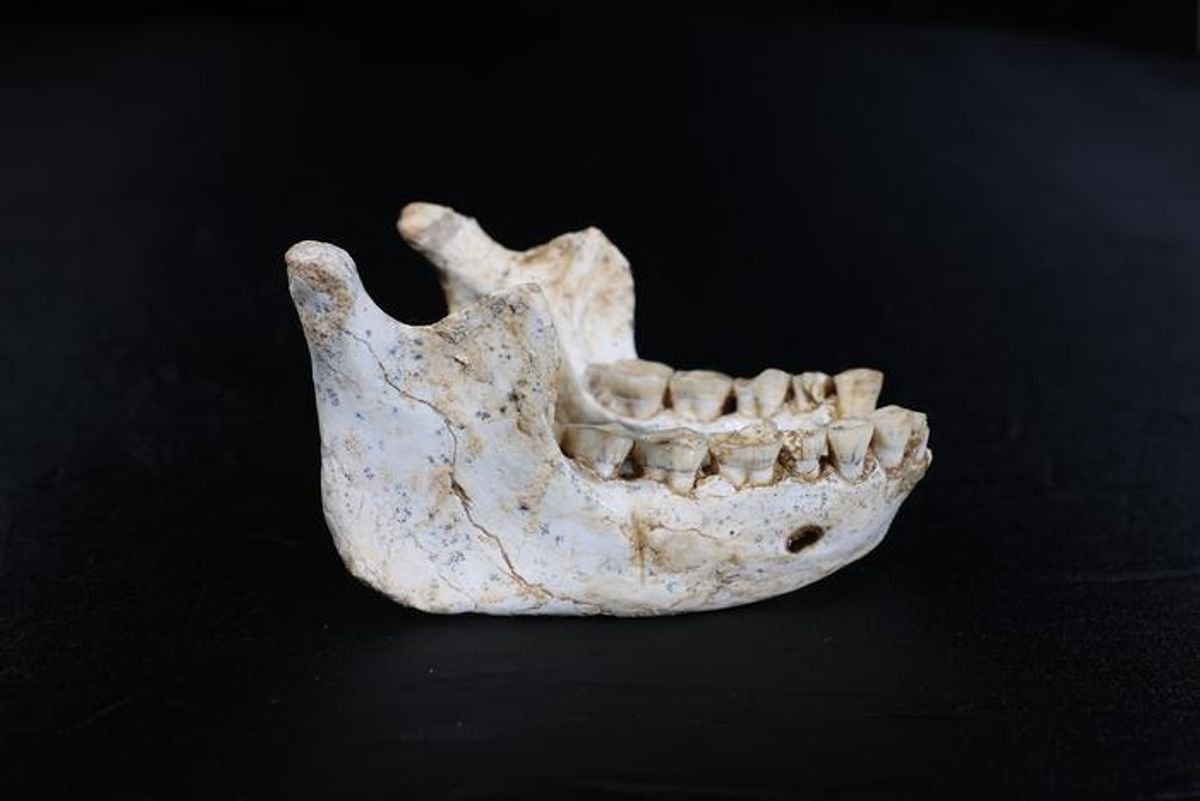
773,000-Year-Old Fossils Capture a Moment Before Human Lineages Split
Along Morocco’s Atlantic coast, hominin fossils dated to about 773,000 years ago have been recovered from a cave sequence. The remains date to around the time — and likely just before — the divergence of the lineages leading to modern humans, Neanderthals, and Denisovans.
Published in Nature, the study reports that fossils from Thomas Quarry I near Casablanca are among the most precisely dated African Pleistocene hominin assemblages identified to date, based on a high-resolution magnetic record preserved in the surrounding sediments. Anatomical analysis of mandibles and other remains places the hominins near the base of later human lineages, while the site highlights the role of northwestern Africa in early Homo evolution.
“The fossils from the Grotte à Hominidés may be the best candidates we currently have for African populations lying near the root of this shared ancestry, thus reinforcing the view of a deep African origin for our species,” said Jean-Jacques Hublin, lead study author, in a press release.
Dating African Pleistocene Hominins
Establishing the age of hominin fossils from the Early and Middle Pleistocene is difficult, in part because sediment layers are often incomplete or disturbed, and many dating techniques carry wide margins of error. At Thomas Quarry I, however, the surrounding sediments preserved a global geological signal that provides an unusually firm anchor in time.

Mandible ThI-GH-10717 during the excavation. Thomas Quarry I, Grotte à Hominidés.
(Image Credit: © J.P. Raynal, Programme Préhistoire de Casablanca)
As sediments accumulate, magnetic minerals within them align with Earth’s magnetic field. When that field reverses polarity — an event that occurs worldwide and nearly simultaneously on geological timescales — it leaves behind a recognizable signature. The deposits at the Grotte à Hominidés record the Matuyama–Brunhes reversal, which occurred about 773,000 years ago.
“Seeing the Matuyama–Brunhes transition recorded with such resolution in the ThI-GH deposits allows us to anchor the presence of these hominins within an exceptionally precise chronological framework for the African Pleistocene,” said Serena Perini, a coauthor of the study.
By analyzing 180 magnetostratigraphic samples, the team placed the fossils directly within the transition itself.
Read More: This 7-Million-Year-Old Fossil May Reveal When Ancient Humans Started Walking Upright
Fossils From an Early Stage of the Human Family Tree
The hominin remains were recovered from what appears to have been a carnivore den. A femur shows clear signs of gnawing, suggesting bodies were dragged into the cave by predators rather than intentionally buried. The assemblage includes a nearly complete adult mandible, fragments of other adult and juvenile jaws, vertebrae, and isolated teeth.

Lower jaws illustrate variation among fossil hominins and modern humans. Tighennif 3 from Algeria (upper left), ThI-GH-10717 from Thomas Quarry in Morocco (upper right), and Jebel Irhoud 11 from Morocco (lower left), compared with a mandible from a recent modern human (lower right).
(Image Credit: © Philipp Gunz, MPI for Evolutionary Anthropology)
Some features resemble hominins of similar age from Europe, including Homo antecessor from Gran Dolina in Spain, while others retain more archaic characteristics. Together, they suggest a population that does not fit neatly into existing species categories.
Using high-resolution micro-CT scans, researchers examined the internal structure of the teeth, focusing on the enamel-dentine junction, which can preserve evolutionary signals even when the outer enamel is worn away.
“Analysis of this structure consistently shows the Grotte à Hominidés hominins to be distinct from both Homo erectus and Homo antecessor, identifying them as representative of populations that could be basal to Homo sapiens and archaic Eurasian lineages,” said Matthew Skinner, a coauthor of the study.
Overall, the dental evidence suggests that regional differences among human populations were already emerging by the end of the Early Pleistocene.
Northwestern Africa’s Role in Human Evolution
The findings reinforce the role of northwestern Africa in early Homo evolution. During the Pleistocene, shifting climates periodically opened ecological corridors across what is now the Sahara, linking North Africa with eastern and southern regions.
“The idea that the Sahara was a permanent biogeographic barrier does not hold for this period. The palaeontological evidence shows repeated connections between Northwest Africa and the savannas of the East and South,” said Denis Geraads.
The precise dating and distinctive anatomy of the Grotte à Hominidés fossils place this region at a pivotal point in the shared evolutionary history of modern humans, Neanderthals, and Denisovans.
Read More: Is There a Benefit to Having Neanderthal DNA in the Human Genome?
Article Sources
Our writers at Discovermagazine.com use peer-reviewed studies and high-quality sources for our articles, and our editors review for scientific accuracy and editorial standards. Review the sources used below for this article: