
700-Year-Old Medieval Document Is the Oldest Written Evidence to Claim the Shroud of Turin Is Fake

The Shroud of Turin is one of the most controversial religious objects on Earth. Claimed to be the piece of linen that Jesus was wrapped in after the crucifixion, historians, devotees, scientists, and more, have challenged the Shroud’s authenticity. And a new study, published in the Journal of Medieval History, showcases an ancient document that dismisses the famous cloth as a fake.
The document, a portion of a treatise that Nicole Oresme wrote during the 14th century, is an important find as it is now the oldest-known official rejection of the Shroud’s authenticity by a highly respected member of society.
“This new discovery of Oresme’s conclusion is particularly important because it confirms that at the time of its composition, likely in the 1370s, that a shroud had been fraudulently presented as authentic in Lirey. And this was widespread news, reaching as far as Paris. This allowed Oresme to cite it in one of his books, confident that his readers would understand what he was talking about,” said world-leading Shroud of Turin expert Andrea Nicolotti in a press release. “Oresme’s opinion is very important because it comes from a person who was not personally involved in the dispute – and therefore had no interest in supporting his own position.”
The Oldest Written Rejection of the Shroud of Turin
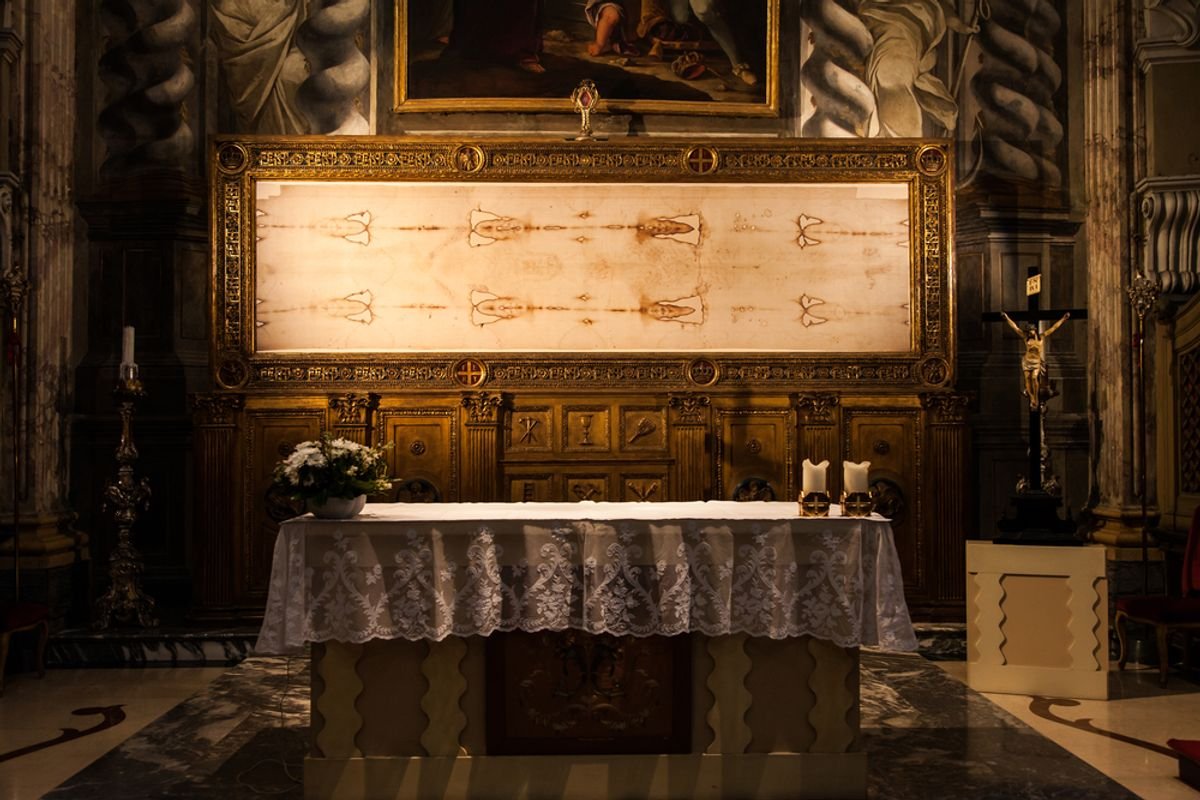
The Shroud of Turin is a 14-foot linen cloth bearing a slight imprint of the front and back of a naked man. Although radiocarbon dating, among other scientific inquiries, has conclusively dated the Shroud’s creation to the 13th or 14th century, many still believe that it is the cloth that contained the body of Jesus after his crucifixion.
Before finding the treatise of Oresme, the oldest known written account of the Shroud’s inauthenticity was by the Bishop of Troyes in 1389. In the Bishop of Troyes’ account, he calls the Shroud a fraud and also points to an earlier account he had read that claimed the same thing.
That earlier account was likely the now-discovered treatise from Oresme. An influential writer on topics like economics, mathematics, physics, astrology, astronomy, and philosophy, Oresme would later become the Bishop of Lisieux in France. He was also well-known for attempting to provide rational explanations for suspected miracles and other religious phenomena.
“What makes Oresme’s writing stand out is his attempt to provide rational explanations for unexplained phenomena, rather than interpreting them as divine or demonic. The philosopher even rated witnesses according to factors such as their reliability, and also cautioned against rumor,” said lead author Nicolas Sarzeaud in the press release.
Read More: Is the Shroud of Turin Real?
Tracing the Shroud of Turin in Medieval Times
Along with identifying Oresme’s document as the oldest written rejection of the Shroud of Turin, the new study also provides some fresh insights into the Shroud’s whereabouts during the 14th century.
Before it was associated with Turin, the shroud was known as the Shroud of Lirey, since that is the French village where it was housed during much of the Medieval period. Oresme would’ve first encountered the Shroud in person here and conducted his assessment.
The Shroud was removed from Lirey around 1355 by order of the Bishop of Troyes who was convinced that the item was fake after many investigations on its authenticity, one of which was likely Oresme’s.
Pope Clement VII in 1389 formally announced the Shroud was as a fake, but it is still on display today in the Cathedral of Saint John the Baptist in Italy and many continue to believe it’s the authentic burial cloth of Jesus of Nazareth.
Read More: A Medieval Preacher’s Meme Helps Solve a 130-Year-Old Literary Mystery
Article Sources
Our writers at Discovermagazine.com use peer-reviewed studies and high-quality sources for our articles, and our editors review for scientific accuracy and editorial standards. Review the sources used below for this article: