
70-Million-Year-Old Dinosaur Egg Reveals Ancient Nesting Clues

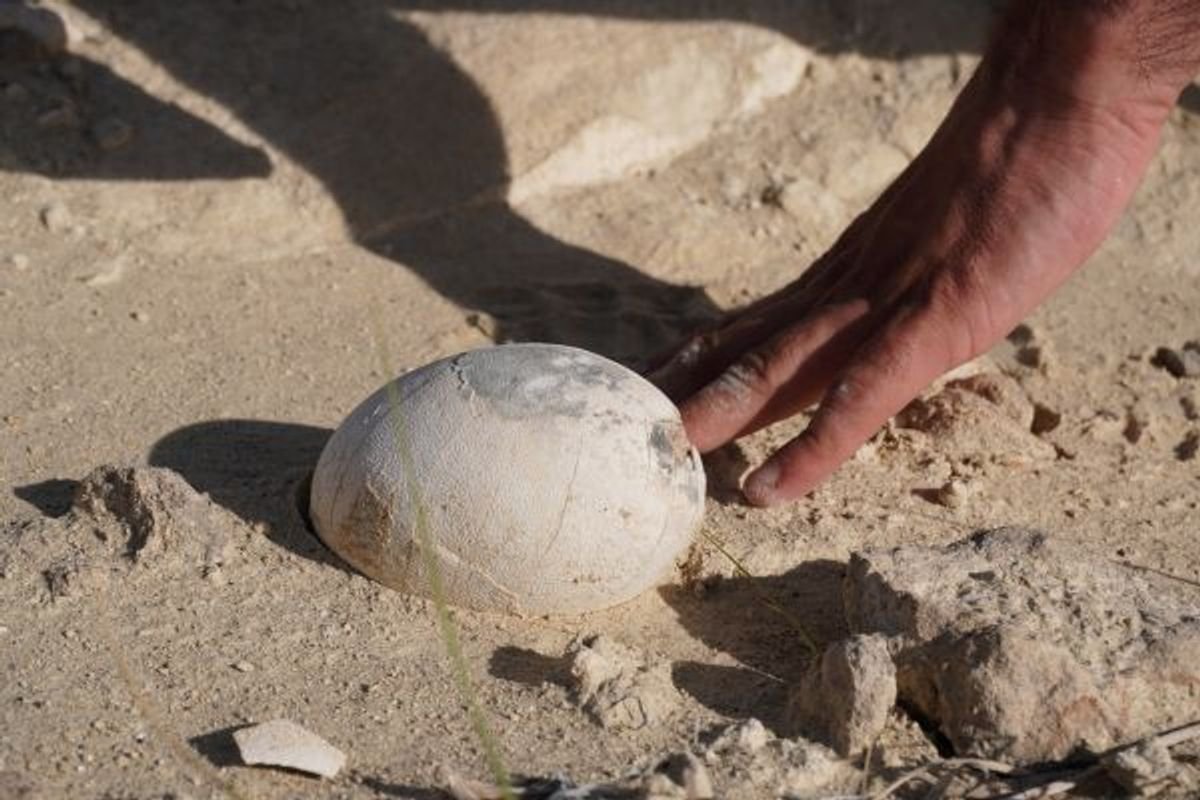
The cameras of the Laboratory of Comparative Anatomy and Evolution of Vertebrates (LACEV) at the Argentine Museum of Natural Sciences captured an unexpected find: a 70-million-year-old dinosaur egg, astonishingly well preserved. The team, led by Argentine paleontologist Federico Agnolín, believes it could be the first complete egg of a carnivorous dinosaur ever found in South America — and that it might even contain embryonic remains inside.
Agnolín and his colleague Matías Motta decided to keep the discovery secret until it was revealed during a live broadcast. They shared the news with their colleagues and the public simultaneously. The reaction was immediate: astonishment, shouts, disbelief. The moment quickly went viral, according to the live stream.
Read More: Unearthing the Most Well-Preserved Dinosaur Embryos
A Paleontological Crown Jewel
It was the unveiling of the crown jewel of Cretaceous Expedition I — the first paleontological campaign ever streamed live online — which had already yielded other major discoveries: fossils of two types of duck-billed dinosaurs, a long-necked dinosaur, all likely new to science, and the remains of tiny prehistoric mammals, no bigger than mice.
“It was already a completely successful campaign because we had found very valuable specimens,” says Agnolín. “But we were lucky enough to find this egg.” The discovery has since earned the reputation of being a true “unicorn” of paleontology.
An Extraordinary Fossil
Fossilized eggs of carnivorous dinosaurs are extremely rare, and the exceptional state of preservation of this specimen makes it one of the most remarkable ever found.
“It’s the most complete, the best preserved, and probably belongs to a species still unknown to science,” Agnolín notes.
The egg’s shape already offers a clue: being oval — more similar to that of a modern bird — it is associated with a carnivorous dinosaur, since sauropod eggs, those of the long-necked giants, are more spherical and have thicker shells.
“It turned white after being exposed to the elements for so long. I looked at it and couldn’t believe it was a fossil,” the paleontologist recalls.
Read More: Were Dinosaurs Good Parents to Their Offspring?
Who Did the Fossilized Egg Belong To?
At first, researchers thought the egg might belong to Bonapartenykus, a small carnivorous theropod from the Late Cretaceous that inhabited the area, but that hypothesis was later ruled out.
“It has a very different ornamentation,” explains Agnolín, after comparing the find with previously known egg fragments. “We believe we’re looking at another kind of carnivorous dinosaur — perhaps one whose adult form is not yet known,” he adds.
To definitively identify the animal that laid it, the team will need to analyze in detail the microscopic layers that make up the shell. They plan to scan the egg with a micro-CT before the end of the year and, as with the initial discovery, broadcast the process live — so that scientists and the public can “be surprised or disappointed in real time.”
“We’ll see if the remains of the embryo’s skeleton are preserved inside. I’m hopeful, but I know it’s very unlikely,” Agnolín cautions.
Dinosaur embryos have been found elsewhere in the world, but they are extremely rare. In Argentina, only sauropod embryos have been discovered — never those of carnivorous species.
If this egg does contain an embryo, it would offer an exceptional opportunity to learn more about its posture, growth, and even its respiratory system.
Cretaceous Period Neighbors
Next to the egg, in the same area of the renowned Allen Formation in Río Negro Province, researchers also discovered Rocasaurus muniozi — a titanosaur that breathed like birds, according to the Institute of Research in Paleobiology and Geology. The team found additional egg fragments and eroded shells that appear to form a nest. This assemblage could provide unprecedented insight into parental care and reproductive behavior in carnivorous dinosaurs shortly before the great Cretaceous extinction.
“There isn’t a single known carnivorous dinosaur nest in South America,” Agnolín points out.
He goes on to explain the significance of the find:
“These animals are the ancestors of birds. So this nest and these eggs will surely help us understand what happened during that transition. Think of a reptile, like a lizard or a turtle: they dig a hole and drop their eggs in. In contrast, modern birds build nests, lay their eggs, incubate them, and raise their chicks. Birds today have highly complex reproductive behavior.”
Prehistoric Bird Lineage
Carnivorous dinosaurs stood right in between. And that’s why Agnolín believes this discovery may offer clues about how nesting behaviors evolved — and why birds began building nests and caring for their young.
“A skeleton doesn’t tell you any of that,” he adds. “It doesn’t reveal whether the animal cared for its offspring, or whether it was social or solitary. A nest, on the other hand, does. And that’s what’s fascinating. It lets us glimpse the behavior of animals that lived 70 million years ago. That’s the true value of this discovery.”
But behind the discovery was an unprecedented gamble: doing paleontology in real time, before thousands of connected viewers.
“We had long wanted to show what our work is really like,” says Agnolín. “Not just the final find, but the whole process — how we think, how we dig, how we uncover the pieces.”
The idea came after watching live broadcasts from an underwater expedition that had sparked unexpected public interest.
“We realized that people were genuinely interested in watching science,” he says. That’s how the Cretaceous Expedition I was born — a campaign that became a collective spectacle of discovery, culminating in a find as unique as the moment it was shared.
Read More: A Stash of Leathery Dinosaur Eggs Tells Us About the Origins of the Giant Reptiles
Article Sources
Our writers at Discovermagazine.com use peer-reviewed studies and high-quality sources for our articles, and our editors review for scientific accuracy and editorial standards. Review the sources used below for this article: