
539-Million-Year-Old Ediacaran Fossils Push Complex Animal Life Back 4 Million Years
In a Cambrian seascape, animals with complex bodies begin to take shape, leaving behind the first imprint of modern life. This moment, around 535 million years ago, marked the apparent beginning of complex animals. But fossils from southwest China were turning up in rocks older than that timeline allowed. They were expected to be simple algae, but some preserved complex features. Then one revealed a mouth and a body built to feed, showing these animals were already around millions of years ago.
In a study published in Science, researchers analyzed more than 700 fossils from the Jiangchuan Biota in southwest China, dating to between 554 million and 539 million years ago. The site preserves what researchers describe as a “treasure trove” of early animals, including some of the oldest known relatives of the group that includes vertebrates. The fossils push these animals into the Ediacaran Period for the first time, suggesting that the lineage leading to backboned animals may have already emerged by then — at least 4 million years earlier than previously thought.
“Once those more complete fossils appeared, it became clear that we were not just looking at unusual algae or isolated fragments, but genuine animal body fossils from the terminal Ediacaran. That was the moment we realized these fossils could have much bigger implications for the timing of early animal evolution,” lead author Gaorong Li told Discover.
Ediacaran Fossils Reveal Early Animals Before the Cambrian Explosion
What sets this site apart is not just its age, but how much it preserves. Most Ediacaran fossil sites capture organisms as faint impressions, leaving little trace of anatomy. At Jiangchuan, fossils are preserved as carbon-rich films, unveiling details like feeding structures, guts, and possible movement-related features.
That level of detail makes it possible to identify animals that would otherwise be invisible in the fossil record, and helps explain why so many of these lineages seemed to appear “suddenly” in the Cambrian.
“It is both surprising and deeply rewarding. For a long time, this has been one of the most fundamental questions in evolutionary paleontology: where are the body fossils of the animals that should have existed before the Cambrian? To finally find a fossil assemblage that preserves not only bilaterians, but also such a range of anatomies, feels incredibly exciting,” Li shared with Discover.
Read More: How Index Fossils Help Reconstruct Earth’s Ancient and Mysterious Past
A Strange Mix of Early Animals
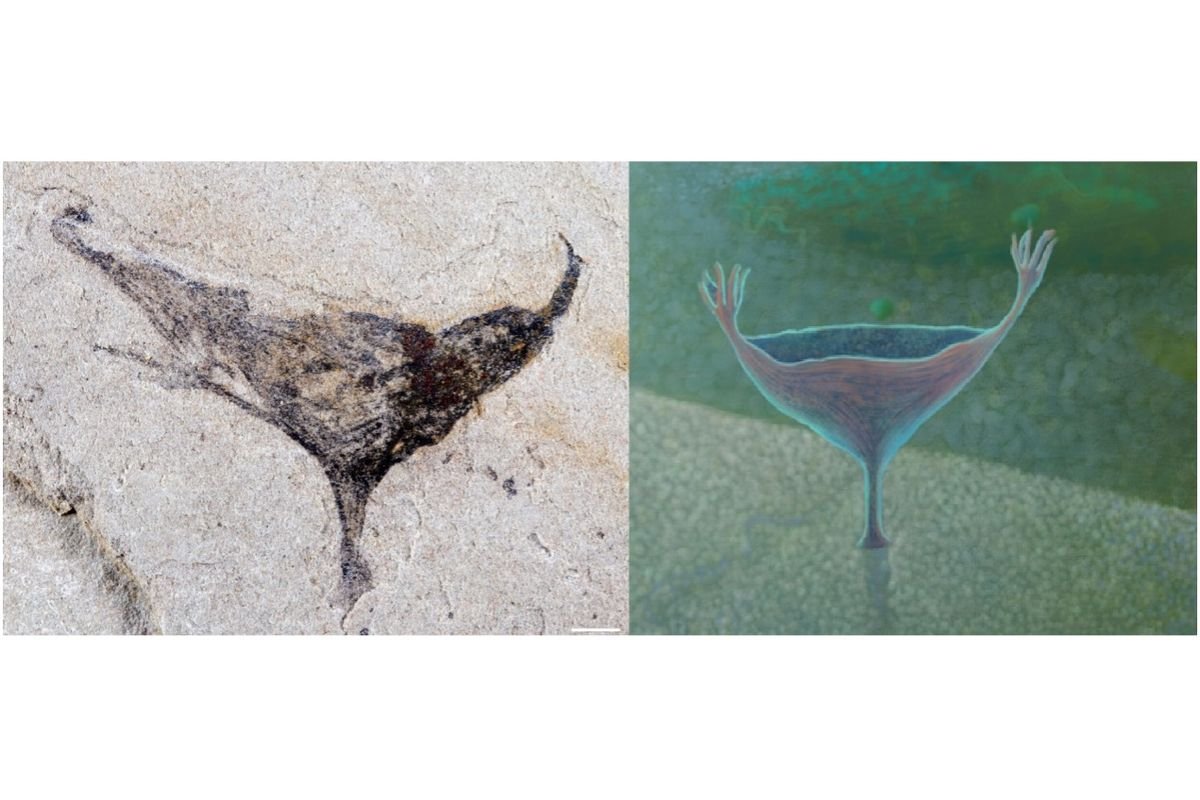
Among them are worm-like bilaterians, rare forms interpreted as early comb jellies, and fossils linked to ambulacrarians, the group that includes modern starfish and sea cucumbers. Some had U-shaped bodies anchored to the seafloor, with tentacles used to catch food. Others reveal internal anatomy, along with combinations of traits that don’t match any known species.

Deuterostome cambroernid fossil.
(Image Courtesy of Gaorong Li & Xiaodong Wang)
Some specimens combine features rarely seen together, with tentacles, attachment structures, and feeding organs appearing in unexpected arrangements. Rather than fitting neatly into known groups, they point to a wider range of early animal forms than the fossil record has captured.
“So instead of thinking of the Cambrian Explosion as a completely sudden appearance of complex animals, we may need to see it more as the ecological and evolutionary expansion of animals that had deeper roots in the late Ediacaran,” Li explained to Discover.
The Cambrian Explosion May Not Be the Beginning After All
If these animals were already present in the late Ediacaran, the Cambrian Explosion may not mark their origin, but their sudden visibility in the fossil record.
Instead of a sharp beginning, the rise of complex animals may have been a longer process — one that was already well underway before the Cambrian began.
“It also gives us a strong sense that this is just the beginning — because once a window like this opens, it immediately raises new questions about how diverse these early animals really were, how they lived, and how much of their history has simply been hidden by preservation bias,” Li told Discover.
Read More: 500-Million-Year-Old Fossil Reveals a Claw That Rewrites the Origins of Spiders
Article Sources
Our writers at Discovermagazine.com use peer-reviewed studies and high-quality sources for our articles, and our editors review for scientific accuracy and editorial standards. Review the sources used below for this article: