
500,000-Year-Old Elephant Bone Hammer Reveals Clever Tool-Making Skills of Early Humans
Our ancient ancestors crafted ingenious tools made not just from stone, but from animal bones too. One such tool, a nearly 500,000-year-old primitive hammer formed out of elephant bone, was recently uncovered in southern England.
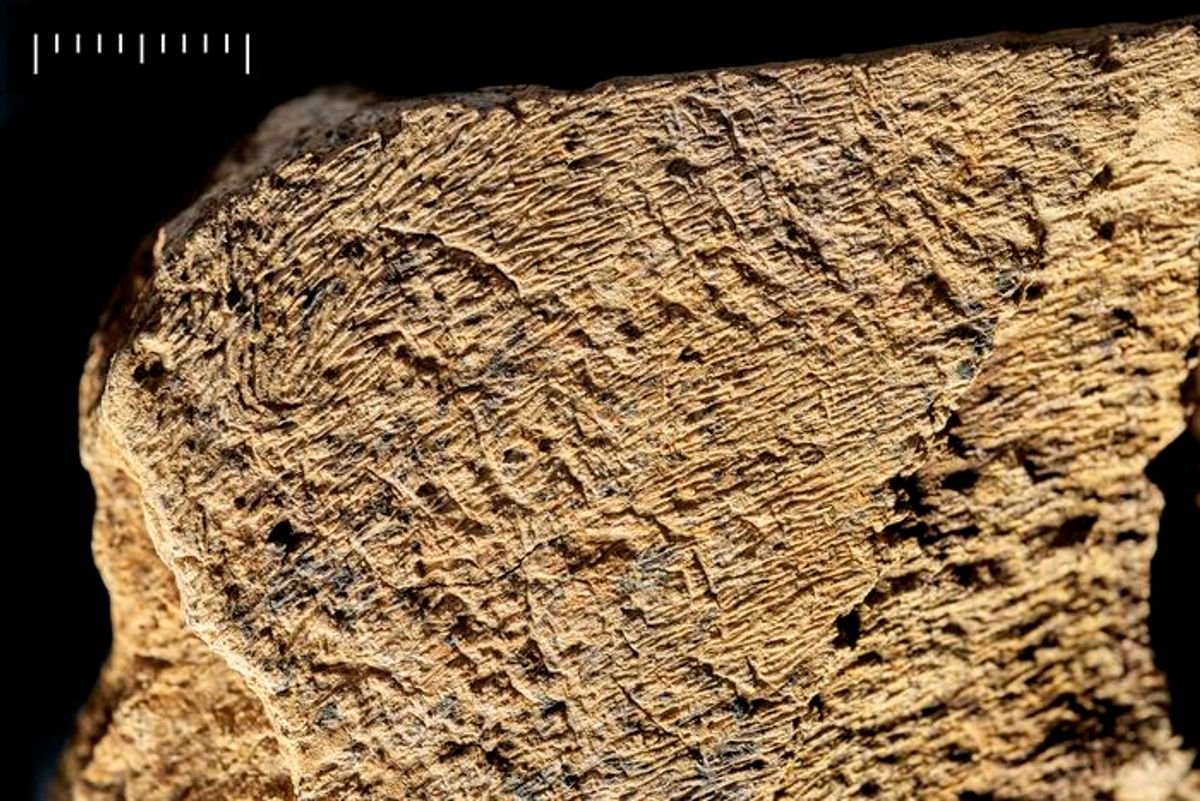
A new study published in Science Advances shows the resourcefulness of the early human species that used the bone hammer to sharpen stone tools. Elephant bone, which would have been a rare resource in prehistoric England, made for the perfect material to repair other tools due to its thickness. Marks on the hammer prove that it had been struck repeatedly against stone, demonstrating a level of technical expertise in early humans.
“This remarkable discovery showcases the ingenuity and resourcefulness of our ancient ancestors,” said lead author Simon Parfitt, a research fellow at University College London, in a press statement. “They possessed, not only a deep knowledge of the local materials around them, but also a sophisticated understanding of how to craft highly refined stone tools.”
The History of Bone Tools and Early Humans
In Europe, evidence of deliberately-made bone tools dates back to around 500,000 years ago. Some archaeological sites in central and southern Europe have revealed shaped bone implements. These early bone tools were used in a variety of ways; some were used to resharpen stone tools. Bone tools found throughout Eurasia were likely first made by Homo heidelbergensis, and then later by Neanderthals, expanding the complexity of bone technology.
But humans’ use of bone tools goes even further back. A March 2025 study uncovered 1.5-million-year-old tools in Olduvai Gorge, Tanzania, that were made from large mammal limb bones. East African hominins used mostly hippopotamus and elephant bones to create the tools, many of which were elongated, pointed, and notched.
The Oldest Elephant Bone Tool in Europe
During the early Middle Pleistocene, the steppe mammoth and the straight-tusked elephant roamed across Europe. However, evidence for elephant bone tools is sparse in Europe before the Late Pleistocene.

Archaeological site from the 1990s, where the elephant bone tool was excavated.
(Image Credit: Boxgrove Project, UCL)
The 500,000-year-old hammer highlighted in the new study represents the oldest elephant bone tool to ever be discovered in Europe. According to the statement, the bone fragment was unearthed in the early 1990s at the archaeological site of Boxgrove, U.K., but it wasn’t designated as a tool until scientists reexamined the site.
“Elephant bone would have been a rare but highly useful resource, and it’s likely this was a tool of considerable value,” said Parfitt.
A team of researchers used 3D scanning methods and electron microscopes to analyze the bone tool. In doing so, they spotted several notches and impact marks indicating that the tool functioned as a hammer. In addition, tiny fragments of flint lodged within the notches hinted that the hammer struck stone many times.
Sharpening Stone Tools
The researchers say that either early neanderthals or Homo heidelbergensis crafted the tool, but the bone fragment is not complete enough for them to know what species it came from. The marks on the bone also indicate that it was relatively fresh when used, but the researchers aren’t sure whether it came from an elephant that had been hunted or from an already dead elephant carcass.
The early humans who made this triangular hammer would’ve used it as a “retoucher,” meaning it was hit against dulled stone handaxes and other tools to sharpen them by chipping away flakes. Elephant bone was the ideal material for the job: It could accomplish more precise techniques due to being softer than stone, but its dense outer layer of tissue (known as cortical bone) made it more durable than other animal bones.
“Our ancient ancestors were sophisticated in their use of tools. Collecting and shaping an elephant bone fragment and then using it on multiple occasions to shape and sharpen stone tools shows an advanced level of complex thinking and abstract thought. They were resourceful gatherers of available materials, and savvy about how best to use them,” said co-author Silvia Bello, a researcher at the Natural History Museum in London.
Article Sources
Our writers at Discovermagazine.com use peer-reviewed studies and high-quality sources for our articles, and our editors review for scientific accuracy and editorial standards. Review the sources used below for this article: