
50,000 Years of Island-Hopping Pigs Reveal Ancient Human Migration
Pigs have spread across some of the most formidable natural barriers on Earth, appearing on islands where most mammals never arrived. From Southeast Asia to remote Pacific islands, they exist on both sides of the famous Wallace Line — a biogeographic boundary that typically stops wildlife in its tracks.
A new genomic study published in Science shows why. By analyzing the DNA of more than 700 modern and archaeological pigs, researchers found that humans have been moving pigs across the Asia-Pacific region for tens of thousands of years. The findings reveal that pig populations across the Pacific are the legacy of repeated human migrations — from early hunter-gatherers to agricultural societies — leaving behind genetic evidence that traces when, where, and how people island-hopped across the region.
“It is very exciting that we can use ancient DNA from pigs to peel back layers of human activity across this megabiodiverse region,” said senior study author Laurent Frantz, in a press release.
Read More: Ancient Bees Found Nested Inside Fossilized Bone — A Behavior Never Seen Before
Early Human Pig Transport

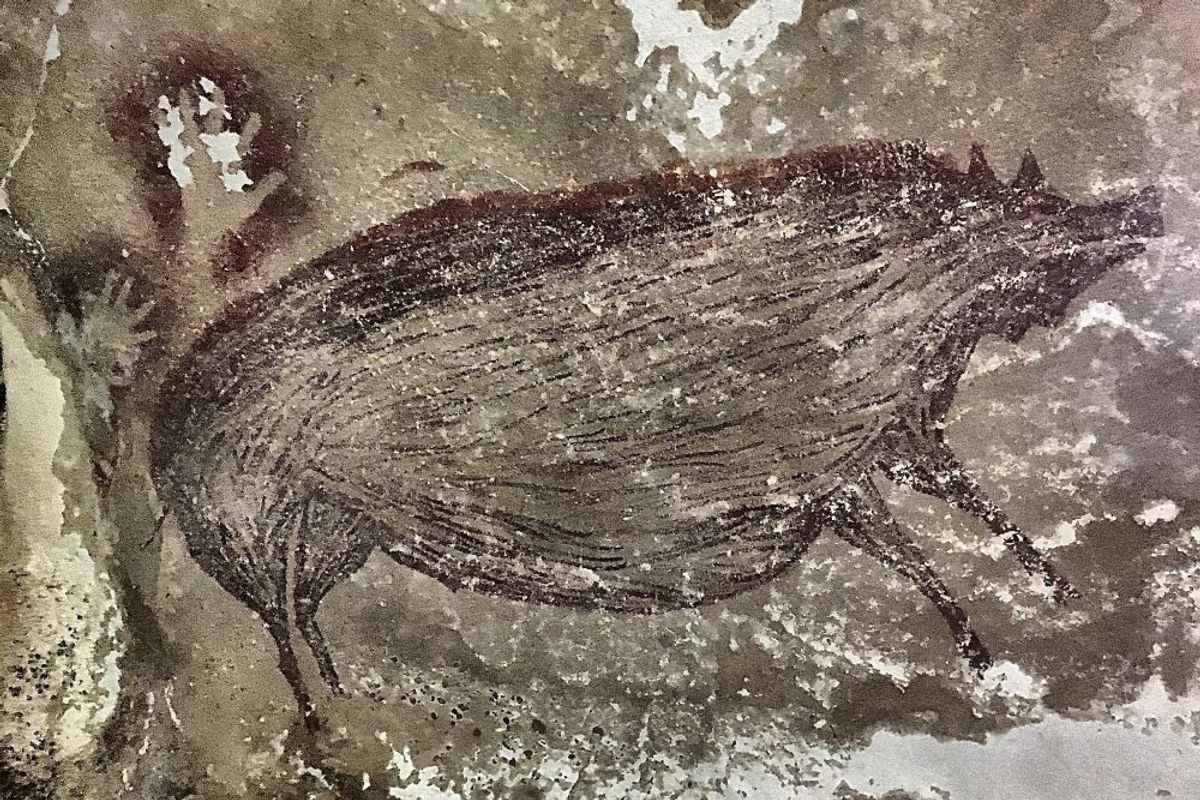
Ancient warty pig cave painting
(Adam Brumm (Griffith University) and Adhi Agus Oktaviana (BRIN, Indonesia))
Genetic evidence suggests people began transporting pigs much earlier than once thought. The study identifies populations living on Sulawesi — possibly as far back as 50,000 years ago — as some of the earliest movers. These groups, known for producing some of the world’s earliest cave art, appear to have carried native warty pigs to neighboring islands such as Timor, potentially to create reliable sources of game.
These early translocations indicate that pre-agricultural societies were already shaping island ecosystems, moving animals beyond their natural ranges long before farming spread across the region.
“This research reveals what happens when people transport animals enormous distances, across one of the world’s most fundamental natural boundaries. These movements led to pigs with a melting pot of ancestries. These patterns were technically very difficult to disentangle, but have ultimately helped us understand how and why animals came to be distributed across the Pacific islands,” said lead author of the study, David Stanton.
Farming and Pig Expansion
Pig movement intensified around 4,000 years ago, as agricultural communities expanded through Island Southeast Asia. According to the study, domestic pigs were carried along routes that began in Taiwan and stretched through the Philippines and northern Indonesia before reaching Papua New Guinea, Vanuatu, and eventually distant Polynesian islands.
Genomic evidence also points to later introductions from Europe during the colonial era, further adding to the genetic complexity of pig populations in the region. Over thousands of years, these overlapping waves of movement produced pig lineages shaped by multiple human cultures.
“Wild boar dispersed across all of Eurasia and North Africa, and certainly don’t need people to help them disperse into new areas. When people have landed a hand, pigs were all too willing to spread out on newly colonised islands in South East Asia and into the Pacific. By sequencing the genomes of ancient and more recent populations, we’ve been able to link those human-assisted dispersals to specific human populations in both space and time,” said co-author Greger Larson.
Pigs in Island Ecosystems
Not all transported pigs remained under human control. Many escaped and became feral, in some cases breeding with older pig lineages that had arrived on islands thousands of years earlier. On the Komodo Islands, for instance, domestic pigs interbred with warty pigs originally brought from Sulawesi — animals that now serve as a key food source for endangered Komodo dragons.
Across the Pacific today, pigs occupy different roles. In some places, they are spiritually significant, in others, agricultural staples, and elsewhere, destructive pests. On certain islands, pigs have become so embedded in local ecosystems that removing them could trigger widespread ecological change.
“The big question now is, at what point do we consider something native?” Frantz said. “What if people introduced species tens of thousands of years [ago], are these worth conservation efforts?”
Read More: Hidden Molecules in Animal Fossil Reveal How the Ancient World Looked
Article Sources
Our writers at Discovermagazine.com use peer-reviewed studies and high-quality sources for our articles, and our editors review for scientific accuracy and editorial standards. Review the sources used below for this article: