
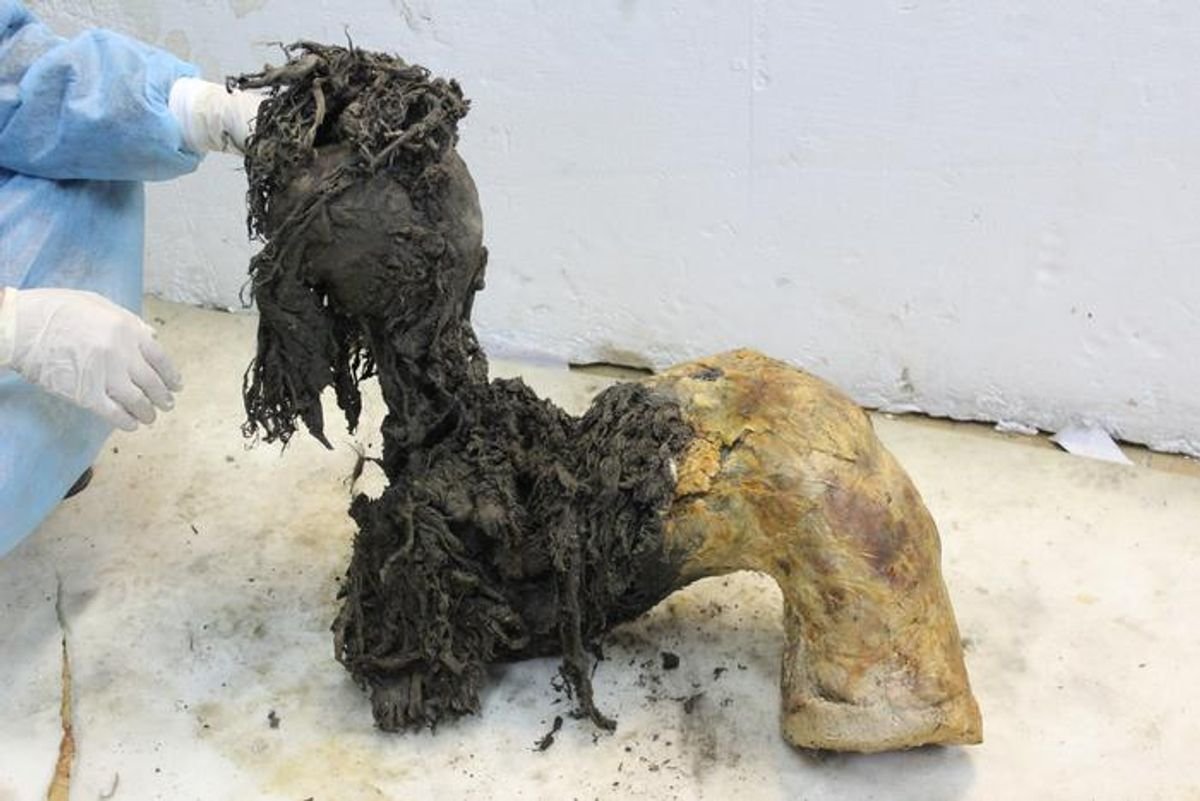
40,000-Year-Old Woolly Mammoth RNA Offers Insight to Megafauna’s Final Moments

Scientists have successfully sequenced RNA belonging to a 40,000-year-old woolly mammoth. Not only do the findings shed light on one of the most celebrated animals of the Ice Age, but the research, published in Cell, shows it is, in fact, possible to recover fragile RNA molecules tens of millennia after death, provided the conditions are right.
“With RNA, we can obtain direct evidence of which genes are ‘turned on,’ offering a glimpse into the final moments of life of a mammoth that walked the Earth during the last Ice Age,” Emilio Mármol, who led the study as a postdoctoral researcher at Stockholm University, explained in a statement.
“This is information that cannot be obtained from DNA alone,” Mármol added.
Read More: With Bushy Hair, This Engineered Woolly Mouse Could Help Revive the Woolly Mammoth
From Woolly Mammoth DNA to RNA
The last surviving woolly mammoths died out around 4,000 years ago due to an unfortunate combination of climate change, human hunting, and possibly a sudden, disastrous event, according to a separate 2024 Cell study. While scientists have since “resurrected” this long-extinct animal using recovered DNA, it was thought that RNA (ribonucleic acid) was too delicate to survive the intervening years.
RNA is present in living cells and plays an essential role in several biological functions, including gene regulation and protein production. While DNA stores an organism’s genetic information, RNA reveals which specific genes are turned on. It was widely thought to degrade rapidly after death, but recent research shows that this is not always the case. So long as conditions are favorable, RNA can survive for hundreds, and even thousands, of years.
The molecules collected from a woolly mammoth are the oldest yet, but scientists have successfully isolated RNA from a 13o-year-old Tasmanian tiger, a 14,300-year-old canine, and Ötzi, the 5,300-year-old Iceman, according to studies in Genome Research, RNA, and Molecular Biology and Evolution.
Decoding The RNA of Ancient Megafauna
For this study, Mármol and a team of scientists from Stockholm University examined soft tissue from 10 mammoths buried in the Siberian permafrost. One — a 39,000-year-old juvenile named Yuka — outperformed the rest in terms of the quality and quantity of the RNA collected.
From this sample, the researchers identified RNA involved in muscle contraction and metabolic regulation in times of stress, “which is perhaps not surprising since previous research suggested that Yuka was attacked by cave lions shortly before his death,” said Mármol.
In total, the team “confidently” identified “fragmentary but reliable evidence” of more than 300 protein-coding messenger RNAs and approximately 60 microRNAs from the mammoth samples. The discovery of microRNAs — a group of non-coding RNAs that are involved in gene expression — was among the most exciting findings of the research.
“The muscle-specific microRNAs we found in mammoth tissues are direct evidence of gene regulation happening in real time in ancient times,” said Marc Friedländer, associate professor at the Department of Molecular Biosciences at The Wenner-Gren Institute at Stockholm University and SciLifeLab, in a statement.“It is the first time something like this has been achieved.”
But that is not all. The analysis of RNA led to another surprising discovery. Yuka was not a female juvenile, as had been previously reported following an external anatomical examination. The young mammoth had XY chromosomes.
“Whether Yuka’s genitalia are indeed female-like, or external sex assignment was the result of misidentification, still remains unclear,” the study’s authors write.
Unlocking The Hidden Layers Of Biology
The ability to retrieve and sequence ancient DNA has already led to major discoveries. It was through DNA analysis, for example, that scientists identified amino acid substitutions that helped woolly mammoths, which are descended from species adapted to life on the hot African plains, survive the frigid climes of Ice Age Eurasia and North America, according to a study in Nature Genetics. The ability to reclaim ancient RNA is yet another tool in the biologist’s arsenal and offers an opportunity to improve our understanding of these long-deceased creatures even further.
“Such studies could fundamentally reshape our understanding of extinct megafauna as well as other species, revealing the many hidden layers of biology that have remained frozen in time until now,” said Mármol.
Read More: A Freeze-Dried Woolly Mammoth Yields 52,000-Year-Old Chromosomes
Article Sources
Our writers at Discovermagazine.com use peer-reviewed studies and high-quality sources for our articles, and our editors review for scientific accuracy and editorial standards. Review the sources used below for this article: