
300 Mysterious Bright Objects in Space May Include Galaxies From the Early Universe
A collection of 300 unusually bright objects in deep space may contain galaxies that formed in the early universe. These objects, captured in infrared images from the James Webb Space Telescope (JWST), have opened up a fresh cosmic mystery that researchers are eager to solve.
A study published in The Astrophysical Journal explains how researchers sleuthed the infrared images to distinguish all 300 objects. Even though the identity of these objects hasn’t been fully uncovered, researchers have good reason to believe that some of them are galaxies from the universe’s formative years.
300 Bright Objects in Space

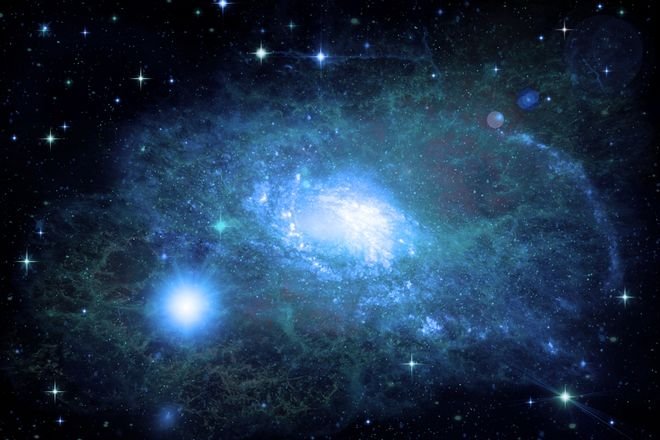
Graphic showing the mysterious objects in the universe that the University of Missouri researchers identified in their study.
(Image Credit: Bangzheng “Tom” Sun/University of Missouri)
The researchers behind the study recognized that the 300 objects were unexpectedly bright, making them prime early galaxy candidates.
According to a press statement on the study, scientists have often interpreted these kinds of extremely bright objects not as early galaxies, but as something else that just mimics them.
Some of the 300 recently discovered objects, however, could be the real deal, researchers say.
“If even a few of these objects turn out to be what we think they are, our discovery could challenge current ideas about how galaxies formed in the early universe — the period when the first stars and galaxies began to take shape,” said study author Haojing Yan, an astronomy professor at the University of Missouri-Columbia.
Read More: Scientists Are Still Trying to Explain Mysterious Space Object ‘Oumuamua’s Odd Behavior
The Redness of Early Galaxies
Confirming whether or not an object is truly an early galaxy, though, is an elaborate process that involves multiple steps.
First, researchers had to gather evidence from JWST’s Near-Infrared Camera and Mid-Infrared Instrument, which together can observe light from the most distant regions of space that hold clues from the early universe.
Detecting faraway objects requires measurement of redshift, which is when light from a source in space stretches into longer wavelengths that become more red in color. A higher redshift means that a galaxy is farther away from Earth and closer to the beginning of the universe.
Once the researchers scoured through the infrared images, they had to carefully identify the 300 objects using a method called the “dropout technique”. This method is meant to detect high-redshift galaxies by looking for objects that appear in redder wavelengths but vanish in bluer wavelengths, which would indicate that light has traveled across vast distances and time.
The red color in high-redshift galaxies can be attributed to the “Lyman break,” which is when ultraviolet light is absorbed by neutral hydrogen clouds.
The Final Steps to Find Early Galaxies
The dropout technique helped the researchers identify each of the galaxy candidates, but they still needed to see whether these objects could be at very high redshifts.
“Ideally this would be done using spectroscopy, a technique that spreads light across different wavelengths to identify signatures that would allow an accurate redshift determination,” Yan said in the release.
However, only a few of the early galaxy candidates had existing spectroscopic data available. For the remaining objects, the researchers turned to a technique called spectral energy distribution fitting, which allowed them to estimate their redshifts and other properties like age and mass.
The researchers focused on 137 objects, finding that the majority (greater than 67.9 percent) are likely low-redshift galaxies. However, a small amount (greater than 7 percent) could still be high-redshift galaxies from earlier in the universe.
The final step to confirm these findings will require spectroscopy, which can reveal key details about a galaxy such as its age, how it formed, and what it’s made of.
“One of our objects is already confirmed by spectroscopy to be an early galaxy,” said lead author Bangzheng “Tom” Sun, a Ph.D. student working with Yan. “But this object alone is not enough. We will need to make additional confirmations to say for certain whether current theories are being challenged.’’
Read More: The Universe’s Earliest Black Hole Dyes Its Home Galaxy a Bright Shade of Red
Article Sources
Our writers at Discovermagazine.com use peer-reviewed studies and high-quality sources for our articles, and our editors review for scientific accuracy and editorial standards. Review the sources used below for this article: