
289‑Million‑Year‑Old Reptilian Mummy Sheds Light on How Amniotes Learned to Breathe
Mummified remains of a 289-million-year-old reptile may contain the oldest example of a breathing system in amniotes.
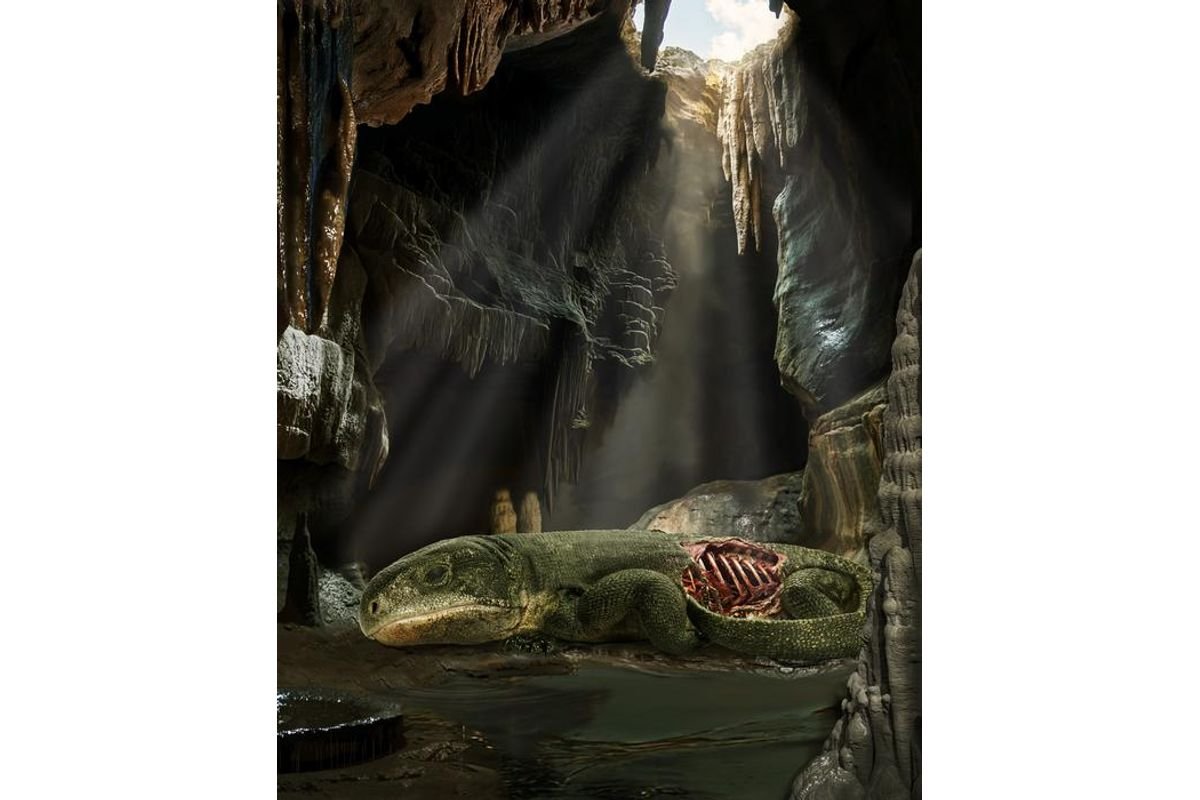
According to new findings published in Nature, the mummy, a reptile known as Captorhinus aguti, is only a few inches long, but preserves bone, calcified cartilage, skin, and proteins that predate previously known soft-tissue evidence of amniote breathing systems by about 100 million years.
“Captorhinus is an interesting lizard-looking critter that is critical to understanding early amniote evolution,” said Ethan Mooney, one of the study’s co-authors, in a press release.
Finding the Mummy, Captorhinus aguti

Fossil and reconstruction of Captorhinus aguti.
Reisz et al. (Nature 2026) diagram altered from Heaton & Reisz (1980). Heaton, M. J. & Reisz, R. R. A skeletal reconstruction of the early Permian captorhinid reptile Eocaptorhinus laticeps (Williston). J. Paleontol. 54,136-143(1980).
(Image Credit: Reisz et al. (Nature 2026) diagram altered from Heaton & Reisz (1980). )
Amniotes are a group of vertebrates that includes birds, mammals, reptiles, and their common ancestors. Captorhinus was one of these early-diverging amniotes that lived during the Paleozoic era, in the early Permian.
Researchers first discovered Captorhinus in a cave system near Richards Spur, Oklahoma, a hotbed of Paleozoic-era fossils. According to the press release, it is home to the most diverse assemblage of terrestrial vertebrate remains known from that era.
The caves in this system contain unique features, including oil-seep hydrocarbons and oxygen-free mud, which contribute to the preservation of animals. As a result, Captorhinus’s remains are preserved in a three-dimensional shape that includes skin, bones, and cartilage. According to the study, the mummy is frozen in its death pose and has one arm tucked under its body.
Read More: Ancient Mummified Cheetahs Found in Saudi Caves Rewrite the Species’ History — And Its Future
Peering Beneath the Rock

Skeletal recreation of Captorhinus aguti
Reisz et al. (Nature 2026) diagram altered from Heaton & Reisz (1980). Heaton, M. J. & Reisz, R. R. A skeletal reconstruction of the early Permian captorhinid reptile Eocaptorhinus laticeps (Williston). J. Paleontol. 54, 136-143 (1980).
(Image Credit: Reisz et al. (Nature 2026) diagram altered from Heaton & Reisz (1980). )
To get a better look at Captorhinus, the team used neutron computed tomography (nCT) to peer through the rocks surrounding the fossil without disturbing it. The results were full of detail.
“I started to see all these structures wrapped around the bones,” Mooney, who was a student at the time of this research, but is now a Ph.D. candidate at Harvard University, said in the press release. “They were very thin and textured. And lo and behold, there was a nice wrapping of skin around the torso of this animal. The scaly skin has this wonderful accordion-like texture, with these concentric bands covering much of the body from the torso and up to the neck.”
According to the study, Captorhinus’s skin looked similar to worm lizards — small, modern-day burrowing lizards.
The Rise of Coastal Aspiration Breathing
Prior to amniotes evolving this breathing system, amphibian breathing strategies — breathing through the skin and moving air to the lungs with their mouths and throats — were dominant. However, this system is not well-suited to the more active amniotes. That system changed as more amniotes evolved.
For this study, the research team examined three Captorhinus specimens from the Oklahoma cave system, each offering clues about breathing. Within one specimen, there were sternal ribs, intermediate ribs, a segmented cartilaginous sternum, and structures that connected the ribcage to the shoulder. The findings are among the first in the fossil record to offer a view of these structures in early reptile species and to reconstruct the complete breathing apparatus in an early amniote.
This apparatus, known as costal aspiration breathing, uses the muscles between the ribs to expand and contract the chest, drawing air into the lungs and expelling carbon dioxide.
“We propose that the system found in Captorhinus represents the ancestral condition for the kind of rib-assisted respiration present in living reptiles, birds, and mammals,” said study co-author Robert R. Reisz in the press release.
The researchers go on to say that the costal aspiration breathing system may have helped drive the diversification of amniotes as they evolved, leading to their becoming land-dominant animals.
“It was a game-changer that allowed these animals to adopt a much more active lifestyle,” said Mooney.
Revealing an Ancient Protein
During their research, the team came upon something they didn’t expect. Using synchrotron infrared spectroscopy to perform a chemical analysis, the team found traces of original proteins within Captorhinus’s cartilage, bone, and skin.
These protein remnants may be the oldest known examples identified in Paleozoic amniotes, according to the study, and are about 100 million years older than other known samples.
“The protein remnant finding is exceptional,” Mooney said in the release. “It dramatically pushes our understanding of what is possible in terms of soft tissue preservation in the fossil record.”
Read More: Scientists Study the Secrets of 2,500-Year-Old Mummified Animals
Article Sources
Our writers at Discovermagazine.com use peer-reviewed studies and high-quality sources for our articles, and our editors review for scientific accuracy and editorial standards. Review the sources used below for this article: