
2,500-Year-Old Iron Age Teeth Reveal How Ancient Childhoods and Diets Unfolded
More than 2,500 years after they were buried, the teeth of Iron Age Italians are still keeping records. Microscopic patterns locked inside dental enamel and plaque reveal when children faced physiological stress, how diets shifted as they grew, and which foods adults regularly ate — including fermented staples that still define Mediterranean cuisine today.
In a detailed analysis of teeth recovered from the Iron Age site of Pontecagnano in southern Italy, researchers combined dental techniques to reconstruct individual life histories from early childhood through adulthood. By tracking growth disruptions in enamel and identifying food residues preserved in dental calculus, the study, published in PLOS One, offers an intimate view of daily life during the 7th and 6th centuries B.C., from early-childhood events to skilled food preparation shaped by wider Mediterranean contact.
“Teeth are a kind of ‘time machine’: they preserve tiny but extraordinarily powerful traces of everyday life. Through them, we can see how past individuals grew, what they ate, and how they faced and reacted to the challenges of their time,” says Roberto Germano, an archaeologist at Sapienza University of Rome and lead author of the study. “And perhaps the most surprising discovery is how much these Iron Age individuals resemble us — they, too, experienced delicate transitions in childhood and consumed fermented foods that remain central to Mediterranean culture today.”
Childhood Growth in Iron Age Italy
The analysis drew on 30 teeth from 10 individuals, with researchers comparing growth features in canine and molar enamel, which mineralize at different points in childhood. That contrast made it possible to chart developmental patterns spanning the first six years of life.

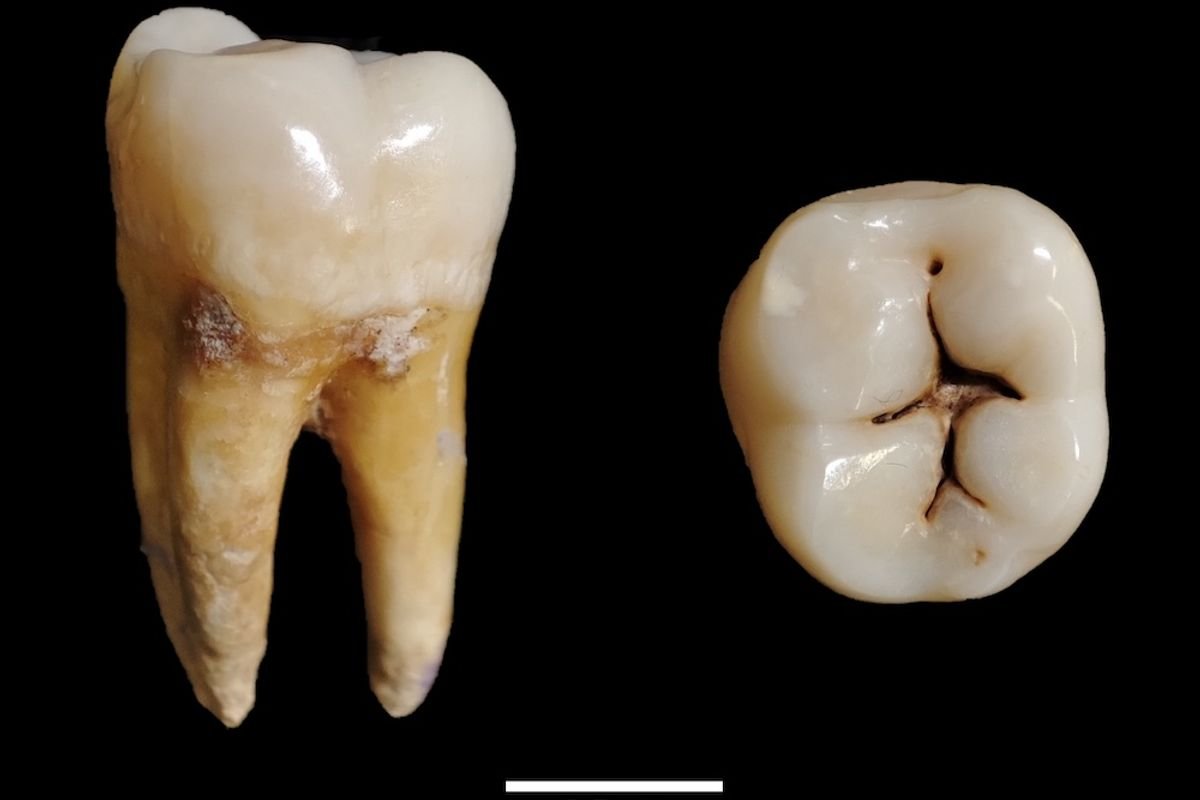
Iron Age tooth during procedures.
(Image Courtesy of Roberto Germano)
Because enamel forms incrementally and does not remodel, disruptions caused by illness, nutritional strain, or environmental stress are permanently recorded. Across the teeth analyzed, two disruption periods appeared, one at roughly one year of age, and another around age four.
“The stress events we identified at one and four years can be related to key biological and social transitions in early childhood,” says Germano.
Rather than pointing to prolonged hardship, the pattern suggests brief physiological challenges tied to moments when children’s diets, mobility, or social environments were changing.
“The stress around one year of age can be related to the weaning period[…]. The second peak, around four years of age, likely reflects a stage when children became more autonomous and increasingly engaged with the community and the surrounding environment,” Germano adds.
Read More: Ancient Shipwreck Cargo Sheds Light on Iron Age Trade And a Lost Mediterranean Seaport
Iron Age Diets and Fermented Foods
Clues preserved in dental plaque point to adult diets built around grains, legumes, other carbohydrate-rich foods, and fermented staples. Similar dietary mixes have been documented at other Iron Age sites, reflecting a period when food resources were becoming more varied as communities in southern Italy engaged more closely with the Mediterranean world.
“The evidence for fermented foods — such as bread, wine, or beer — suggests not only a complex approach to food preparation, but also cultural connections, since these techniques were widespread across the Mediterranean,” the authors said in the study.
Reconstructing Iron Age Lives, Tooth by Tooth
The Pontecagnano analysis marks the first time dental histology has been applied to this Iron Age community. Although the number of individuals examined is small, the study shows how combining enamel growth analysis with calculus examination can move archaeology beyond broad population trends.
Rather than focusing on the period close to death, this approach allows researchers to reconstruct biological life histories over time. Future work could expand the method using isotopic and geochemical techniques to explore mobility and long-term dietary change.
“This study paves the way for a more integrated reconstruction of the biological life histories of ancient humans,” Germano says.
Read More: Bronze and Iron Age People Focused on Olive and Grape Crops, Making Wine and Olive Oil a Priority
Article Sources
Our writers at Discovermagazine.com use peer-reviewed studies and high-quality sources for our articles, and our editors review for scientific accuracy and editorial standards. Review the sources used below for this article: