
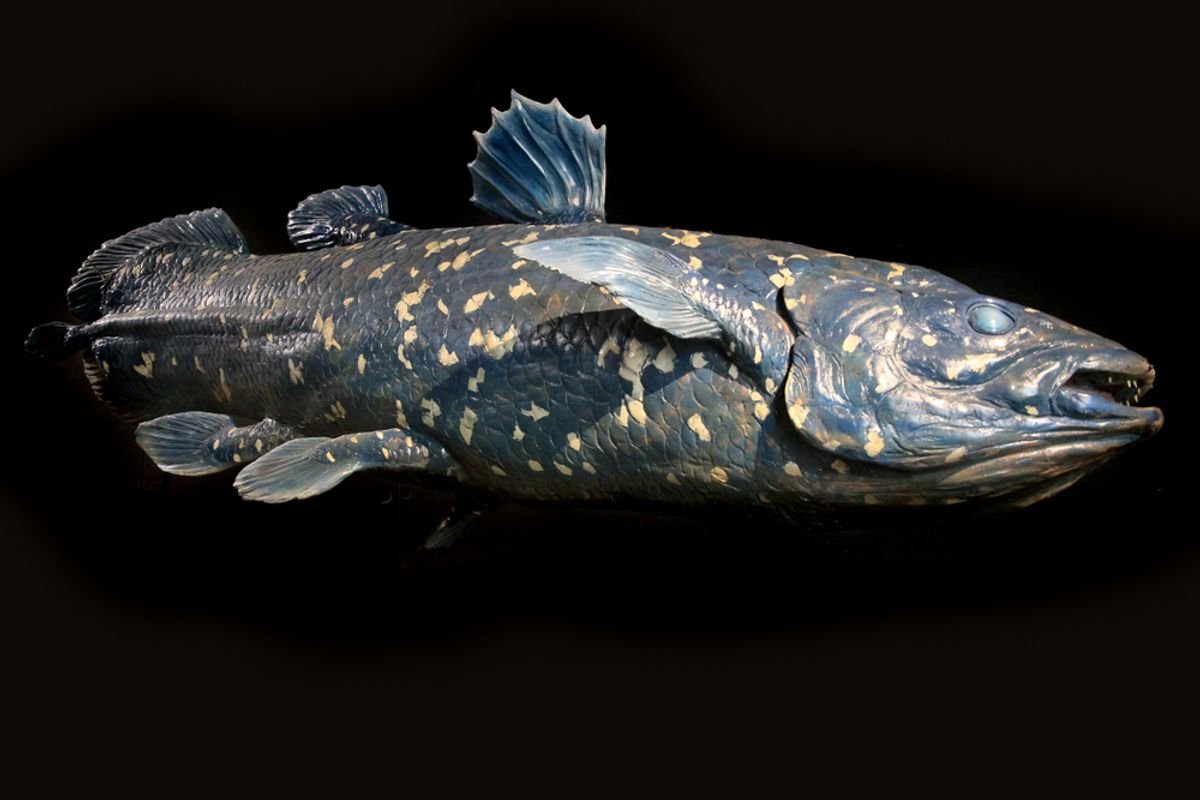
240-Million-Year-Old Coelacanth May Have Used Lungs to Hear Underwater

More than 200 million years ago, some deep-sea fish may have been listening to their surroundings in an unexpected way — not just with their ears, but with their lungs.
A new study in Communications Biology describes ancient coelacanths, a group of fish that lived during the Triassic period, using a lung-like organ to detect sound underwater. The findings point to a previously unknown sensory system, showing that early vertebrates may have detected sound in ways that no longer exist today.
“Our hypothesis is based on analogies with modern freshwater fish such as carp or catfish. In these species, a structure known as the Weberian apparatus connects the swim bladder to the inner ear. This system allows them to detect underwater waves,” said the first author of the study, Luigi Manuelli, in a press release.
Read More: Living Fossils Like the Coelacanth Have Remained Unchanged for 400 Million Years
Ancient Triassic Fish Hearing
Coelacanths are often described as “living fossils,” but their evolutionary history is more complex than that label suggests. While modern species — represented today by the genus Latimeria — live in marine environments and rely entirely on gills, their relatives occupied a wider range of habitats and had very different anatomies.
Some Triassic coelacanths had a well-developed lung covered in small, overlapping bony plates (resembling roof tiles). Until now, researchers thought that structure was a tool for breathing air — something that didn’t fully account for its unusual shape or structure.
To investigate further, researchers analyzed fossils from northeastern France using synchrotron imaging, a high-resolution X-ray technique capable of revealing internal structures in fine detail. The scans showed a well-preserved lung with wing-like extensions at one end, hinting at a function beyond respiration.
A Lung Linked to Hearing
The breakthrough came when the fossil data were compared with modern coelacanth embryos. In these living species, researchers found a narrow canal connecting organs responsible for hearing and balance on either side of the skull. The fossil and developmental evidence suggest these structures once worked as a single system.
In ancient coelacanths, the lung may have acted as a receiver for sound waves in the water. Vibrations picked up by the air-filled organ could then have been transmitted through the canal to the inner ear, allowing the fish to detect low-frequency sounds that would otherwise pass unnoticed.
The setup resembles a known system in some modern fish, including carp and catfish. In those species, a structure called the Weberian apparatus links the swim bladder to the inner ear, enhancing sensitivity to sound.
The key element is the air-filled cavity. Because sound travels differently through water and tissue, the presence of air allows subtle pressure changes to be detected more effectively.
A Sensory Ability That Faded Over Time
This lung-based hearing system has so far been identified in only two Triassic coelacanth species, but researchers think it may have been more common among their relatives. Over time, however, that ability appears to have disappeared.
As the ancestors of modern coelacanths moved into deeper marine environments, their lungs gradually shrank and lost their original function. In those conditions, a lung-based sensory system may no longer have been useful. Even so, parts of the inner ear anatomy remained.
“These anatomical remnants now provide valuable insight into the evolutionary history of these fish — and perhaps also into that of our own aquatic ancestors,” research lead Lionel Cavin explained in the press release.
The findings highlight that early vertebrates may have experimented with a wider range of sensory strategies than previously thought, including using organs originally evolved for breathing to help them hear.
Read More: Fossils of Extinct Coelacanths Faced a Case of Mistaken Identity for Over a Century
Article Sources
Our writers at Discovermagazine.com use peer-reviewed studies and high-quality sources for our articles, and our editors review for scientific accuracy and editorial standards. Review the sources used below for this article: